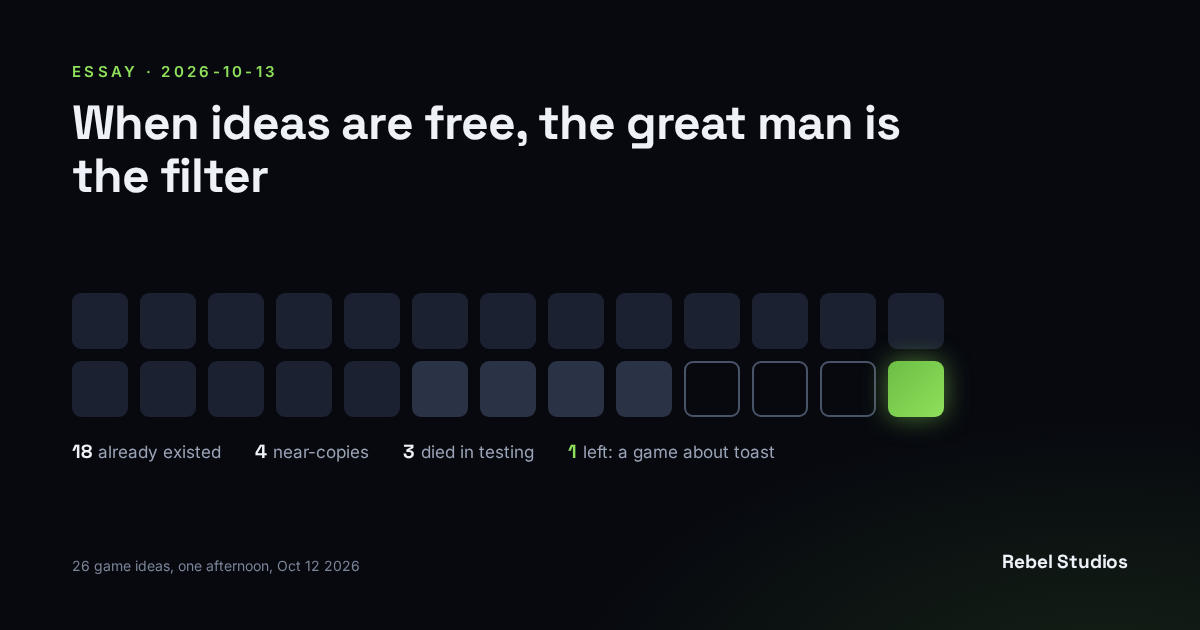
On October 12 we wrote down 26 ideas for a phone game, then searched the App Store, Google Play, Steam, itch.io and BoardGameGeek for each one. Eighteen already existed in close form. Four more were near-copies of things people already play. Four survived the search, and three of those died when we worked through their rules, one on paper and two in simulation: one had a move that was always right, one rewarded a single fixed pattern, and in one the obvious route did as well as careful play.
The one left is a game about toast. That afternoon was the oldest argument about where good ideas come from, run faster than anyone in it could have pictured.
Carlyle, Spencer, and a list of 148
In May 1840 Thomas Carlyle opened six lectures with a sentence that still sits underneath most founder biographies: “Universal History, the history of what man has accomplished in this world, is at bottom the History of the Great Men who have worked here.” Change the man and you change the century.
Herbert Spencer answered in 1873 with a line that’s hard to improve on: “Before he can remake his society, his society must make him.” The great man is real. So is everything that had to exist before he could.
The best evidence for Spencer is how often the great idea arrives twice. In 1922 the sociologists William Ogburn and Dorothy Thomas listed 148 inventions and discoveries made independently by two or more people. Newton and Leibniz both worked out calculus. Darwin and Wallace both arrived at natural selection. Scheele and Priestley both found oxygen. When the parts are lying around, somebody puts them together, and often several somebodies do.
William James split the difference in 1880, and his version is the one that fits now. He compared great men to Darwin’s variations. Nobody can say why a particular genius appears, just as Darwin couldn’t say why a particular variation did. What you can study is what happens next, and there James was blunt: the environment “chiefly adopts or rejects, preserves or destroys, in short selects him.”
Variation used to be the scarce part
For most of history an idea came out of one head, slowly, and testing it took years. AI changes the supply. Anyone can now produce more variations in an hour than they can read in a day, and everyone else is doing the same with the same models. Two things follow, and we’ve run into both.
The second inventor now shows up the same week. Ogburn and Thomas collected their 148 multiples across centuries. We collected 18 in an afternoon. The day before, we had planned a tool that catches the lies trading backtests tell. The competitor search we run before building anything turned up several free tools already doing it, and a developer published an article on the same subject, with a free browser tool, on the day we had the idea. “Has anyone else thought of this?” now has a fast answer, and the answer is usually yes.
More attempts means more lucky winners. We looked closely at Kaggle’s Hull Tactical market-prediction competition, which finished this summer. 3,294 teams entered models that were scored on six months of live market data. The leaders’ scores looked like genius. But six months of one kind of market, spread across three thousand entries, can produce scores like that by luck alone, and the median team did about what simply holding the index did. When everyone can make thousands of attempts, every batch has a lucky tail, and the lucky tail is who gets profiled. Expect more great-man stories from the AI years, and expect each one to mean less.
So where did the great man go?
If ideas are cheap and attempts are cheap, Carlyle’s hero can’t live in the idea anymore. James already told us where to look: in the selecting.
We learned that the slow way. Over the past three weeks we’ve tested more than a dozen ways to beat the market, from copying famous investors’ filings to following insiders’ purchases to asking pretrained forecasting models. None beat simply holding. The useful things we built along the way weren’t strategies. They were the tests: rules written down before any result is seen, a single run on data the strategy never touched, and a benchmark that’s hard to beat.
The toast game is the same story. Nobody had a brilliant idea. It’s what was left after a search for existing games, then a simulation in which a bot that taps one button over and over has to lose, then my own hands on a phone. My first verdict was that I had no idea how to play it. That sentence was worth more than the idea, because the bots had said everything was fine.
So here is our answer to the old question. AI doesn’t end the great man theory. It moves him. The person who matters is less the one with the idea than the one who builds the filter, and then believes it when it says no.
The chapter nobody writes
Biographies tell the idea and the triumph. They skip the killed ideas, because a killed idea isn’t a story. That was fine when a person had a handful of ideas in a lifetime. Now one person can kill twenty-five before lunch, and the habits worth having are the ones that do the killing honestly:
- Look for the copies before you build. Most of ours existed.
- Decide what counts as a win before you see results. With enough attempts, something always looks like genius afterwards.
- Put a person in front of it early. Our bots called the toast game fine. A person called it baffling, and the person was right.
What we don’t know
We’re a small studio, and these are field notes, not a law of history. The toast game may flop. One person working with AI agents has produced a great many tests and, so far, very little revenue. Our own operating notes quote Jobs, Musk and Bezos, so we’re hardly immune to hero worship. But the record of the last month is plain: in our work, the heroes were the tests.
Carlyle wrote the biography of the hero, and Spencer wrote the biography of the times. AI makes a third one worth writing: the biography of the filter. It’s the dullest chapter in any success story, and it’s where the leverage went.