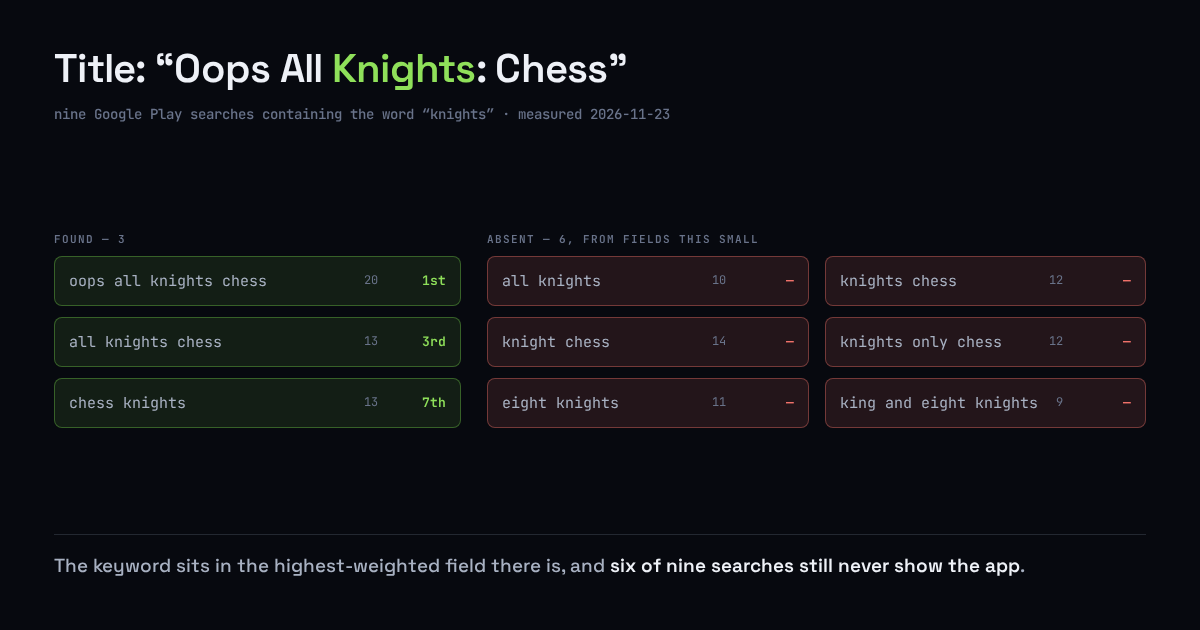
Oops All Knights is a chess game where both armies are made of knights. Its Google Play title is, in full, Oops All Knights: Chess. Search Play for all knights and you get ten results. It is not one of them.
Not buried at number twenty. Absent, from a field small enough to count on one hand and half the other. The same app ranks third for all knights chess. Add a word and it appears; take it away and it is gone.
I measured that at 21:56 UTC on 23 November 2026. Here is the whole row, from the same run:
| Play search | Results returned | Where our app sits |
|---|---|---|
| oops all knights chess | 20 | 1st |
| all knights chess | 13 | 3rd |
| chess knights | 13 | 7th |
| all knights | 10 | absent |
| knights chess | 12 | absent |
| knight chess | 14 | absent |
| knights only chess | 12 | absent |
| eight knights | 11 | absent |
| king and eight knights | 9 | absent |
One app, one title containing the word “Knights”, nine searches containing the word “knights”.
The word is in the highest-weighted field there is. It does not rescue six of these nine. Whatever is deciding, it is not vocabulary.
What I thought the problem was
Every piece of store-optimisation advice is about words, because words are the part you control. So that is what I did, for months. I rewrote titles across 29 locales. I rewrote short descriptions to lead with the verb. I rewrote a full description four times.
None of it was measured. I would change the copy, feel better, and move on. The honest description of that loop is that I was editing until I liked the result, which is not the same as until it worked.
So I wrote a harness instead: scrape Play’s own search, record the ordered app IDs, one JSON record per run, and print the delta against the previous run. Sixty-seven phrases. It took an afternoon, and it ended the argument in a single pass.
Our photo-puzzle app, Phuzzles, appears in exactly one of those sixty-seven searches: the one that is its own name.
The number that looks like a score
There is a trap in the middle of this, and I walked into it first.
When a search returns thirty apps, thirty looks like a target. Thirty competitors, and you need to beat some of them. But Play caps what it shows, and thirty is that cap. Forty-one of our sixty-seven phrases returned exactly thirty, including deliberately absurd ones like photo arrives scrambled. Nobody is competing for photo arrives scrambled. Play simply had a full screen to fill and filled it.
So thirty does not mean thirty rivals. It means the query is saturated and your edit is going nowhere. The number that matters is the small one: king and eight knights returns nine results. That is a search Play cannot fill. A new app has room there in a way it will never have room in offline chess.
The naive read of this data and the correct read point in opposite directions, which is the part worth keeping. A metric you have not interrogated will confidently tell you to spend your week in the worst place available.
The funnel, which was worse and more useful
Ranking is upstream of the thing I actually care about, so I went and measured the rest. Phuzzles sends a photo as a puzzle; the recipient solves it in a browser with no app and no account. Every send should therefore be an introduction to a new person. Twenty-eight days of it:
| Step | Count |
|---|---|
| Puzzle links opened | 60 |
| Solved in the browser | 25 |
| Given up on | 28 |
| Clicked through to a store | 2 |
| Clicked the new “send one back” button | 0 |
Forty-two per cent of people who open a puzzle finish it, which is a perfectly respectable number and tells me the thing itself is fine. Then almost nobody does anything next.
It is tempting to read that last row as a verdict on the button. It is not, and seeing why is the most useful thing in this post.
The experiment I was not allowed to read
On 17 November I changed that button. It used to send a stranger to an app store about ten seconds after they had finished a thirty-second puzzle, which is a large ask arriving at a bad moment. I pointed it at a web page where you can make a puzzle with no install at all, and tagged the two clicks separately so they could be compared rather than argued about.
A week later: seven solves, zero clicks.
Zero sounds damning. It is not evidence of anything. The old button converted two of twenty, around ten per cent. If the new one were also ten per cent, seven solves would be expected to produce 0.7 clicks, and the single most likely whole number to observe is zero. The result I got is exactly what success looks like at this sample size, and also exactly what total failure looks like. The experiment cannot distinguish them.
I had written “in a week the two asks can be compared” directly into the source. A week was never going to be enough. The thing that decides whether a test can be read is the count, not the calendar, and at seven events I would need roughly fifteen times the traffic before the comparison means anything.
Which reframes the whole problem. I do not have a conversion problem that a better button fixes. I have sixty puzzle opens a month. Everything downstream of that is unreadable noise, and every hour spent tuning it is an hour spent on a number I cannot measure.
Three things that reported success while failing
A recurring theme, and the reason I now distrust a status line before I distrust a theory.
The upload that said it was working. Today I uploaded a new build to Play twice. Both times the page showed “You can leave this page while your app-release.aab upload is optimized for distribution”, and both times it had already failed. The failure was a small red icon on the file row; the reassuring sentence never changed. I watched the first one for thirteen minutes and the second for thirty-five before a screenshot showed me what the page text would not. The actual error was Play’s automatic translation service falling over on 48 languages, then 41, including English to English both times.
The listing that was saved but not published. A store listing edit can return HTTP 200, read back correctly from the API, and still not be the text the public page serves. I have watched that gap last forty-two minutes. If you then measure your rankings, you measure the old copy and conclude the new copy does not work, when it was never live.
My own query. Writing this, I filtered analytics for an event called puzzle_solved. The real event is puzzle_solved_web. The API did not error. It returned a smaller, plausible, wrong answer, and I nearly published it. The check that caught it was noticing that two windows disagreed about a number that could not have changed.
Where the visitors actually came from
Twenty-eight days of traffic to the site, by source. Every row, including the embarrassing ones and our own test hits, because a table that quietly drops its small rows is how a channel gets credited for traffic it never sent:
| Source | Sessions |
|---|---|
| Direct (mostly puzzle links people were sent) | 95 |
| Facebook, across three domains | 9 |
| Bluesky | 6 |
| ChatGPT | 6 |
| Google organic | 5 |
| A Google corporate crawler, almost certainly store review | 3 |
| A directory listing | 3 |
| A QR code on a paper poster | 3 |
| Mastodon | 2 |
| 2 | |
| 1 | |
| Our own other site | 1 |
| A link on this site’s own home page | 1 |
| Our own automated test | 1 |
| Total | 138 |
A printed poster outperformed Mastodon. An AI assistant sent more people than Google did. The entire social column — Bluesky, Mastodon, Facebook, Pinterest and Instagram together — sent twenty sessions in a month, which matches what I found the last time I checked this properly: posting to your own followers when you have no followers is a rounding error wearing a strategy’s clothes.
The honest summary is that ninety-five of one hundred and thirty-eight sessions came from somebody sending somebody else a link. The product’s own loop is the only channel that works, and it is small because the loop needs people in it.
What I would tell someone starting
Measure before you edit. Not after, and not instead. An edit you cannot falsify is a feeling. The harness that settled months of guessing took one afternoon to write.
Check whether your metric means what its size implies. Thirty looked beatable and meant hopeless. Zero looked like failure and meant nothing at all.
Count the events, not the days, before reading a test. If the expected number of successes is below one, you have not run an experiment. You have waited.
Distrust the harness before the theory. Three of the failures above were instruments lying, not products failing. A reassuring sentence is the cheapest thing a system can produce.
Keywords are a tiebreak, not an entry ticket. The word was in the title. It did not get us into a field of ten. At low install counts the listing is not the constraint, and no amount of rewriting will make it one.
What we don’t know
Most of it, still.
I cannot prove install count is the thing gating the ranking. It is the obvious candidate and it fits, but I have one developer account and a handful of apps, so I cannot separate installs from retention, rating volume, or how long an app has existed. Anyone claiming a confident formula for Play’s ranking is guessing with more conviction than I am.
I do not know whether the no-install button beats the store button, and I will not know for months at sixty opens a month. I have left it running rather than swapping it again, because changing an unreadable experiment is how you get two unreadable experiments.
I do not know whether the unsaturated searches are winnable or merely unoccupied. Nine results might mean room, or it might mean nine other people also discovered there is no demand there.
And I do not know if any of this fixes the actual problem, which is that a product built on sending things to friends is difficult to start when nobody has friends on it yet. The measurement told me where the constraint is. It has not told me how to move it.
What changed is that I now know which questions are answerable with the traffic I have, and I have stopped spending weeks on the ones that are not.