You have an API worth money — a data feed, a model, a lookup, a piece of compute. Traditionally, monetizing it means building the whole apparatus around it: a signup flow, API keys, a billing system, usage metering, dunning emails when a card fails. That machinery exists to serve human customers who subscribe.
AI agents are different customers. An agent does not want to sign up for your service; it wants to call your endpoint once, pay for that one call, and move on. The x402 protocol lets you serve exactly that — per-call payment, no accounts, no keys. This is the practical guide to doing it, drawn from building gate402, a gateway that fronts paid APIs for agents.
The Core Idea: Payment Is Just Another Header
x402 turns paying into part of the ordinary request/response cycle. An agent requests your endpoint; if it hasn’t paid, you answer with 402 Payment Required and a small machine-readable description of the price and where to pay. The agent pays, retries the same request with a payment attached, and you return the data.
The agent needs no prior relationship with you. It discovers the price from your 402 response and pays on the spot. You need no user table, no key store, no subscription logic.
What a Paid Endpoint Returns
Concretely, the “please pay” response is a normal 402 with a JSON body telling the agent what the call costs and how to pay for it. The shape is simple:
HTTP/1.1 402 Payment Required
Content-Type: application/json

{
  "x402Version": 1,
  "accepts": [
    {
      "scheme": "exact",
      "network": "base",
      "asset": "USDC",
      "maxAmountRequired": "10000",   // 0.01 USDC (6 decimals)
      "payTo": "0xYourWalletAddress",
      "resource": "/v1/forecast",
      "description": "One 7-day forecast"
    }
  ]
}
The agent reads that, constructs a payment for the exact amount, and retries the request with the payment proof attached in a header. Your server verifies the proof and, if it’s valid, returns the real response.
The Two Ways to Build It
You have a choice about how much of this plumbing you own.
Option A: Integrate x402 directly
You add x402 middleware to your API. It intercepts unpaid requests, returns the 402, verifies incoming payments against a settlement layer (a “facilitator” that confirms the on-chain transaction), and lets verified requests through. In broad strokes:
// pseudocode — the shape, not a specific SDK
app.use("/v1", async (req, res, next) => {
  const payment = req.header("X-Payment");

  if (!payment) {
    return res.status(402).json(priceQuote("/v1/forecast", "0.01"));
  }

  const ok = await facilitator.verify(payment, "0.01", "USDC");
  if (!ok) {
    return res.status(402).json({ error: "invalid or insufficient payment" });
  }

  await facilitator.settle(payment);   // move the funds
  next();                               // let the real handler run
});
This gives you full control and keeps every cent, but you own the wallet management, settlement, retries, and edge cases (partial payments, replays, refunds).
Option B: Put a gateway in front
The faster path is to let a gateway handle the payment layer while you keep writing plain HTTP handlers. Your API stays a normal, unauthenticated internal service; the gateway sits in front, speaks x402 to the outside world, verifies and settles payments, and forwards only paid requests to you. You never touch a wallet or a settlement library.
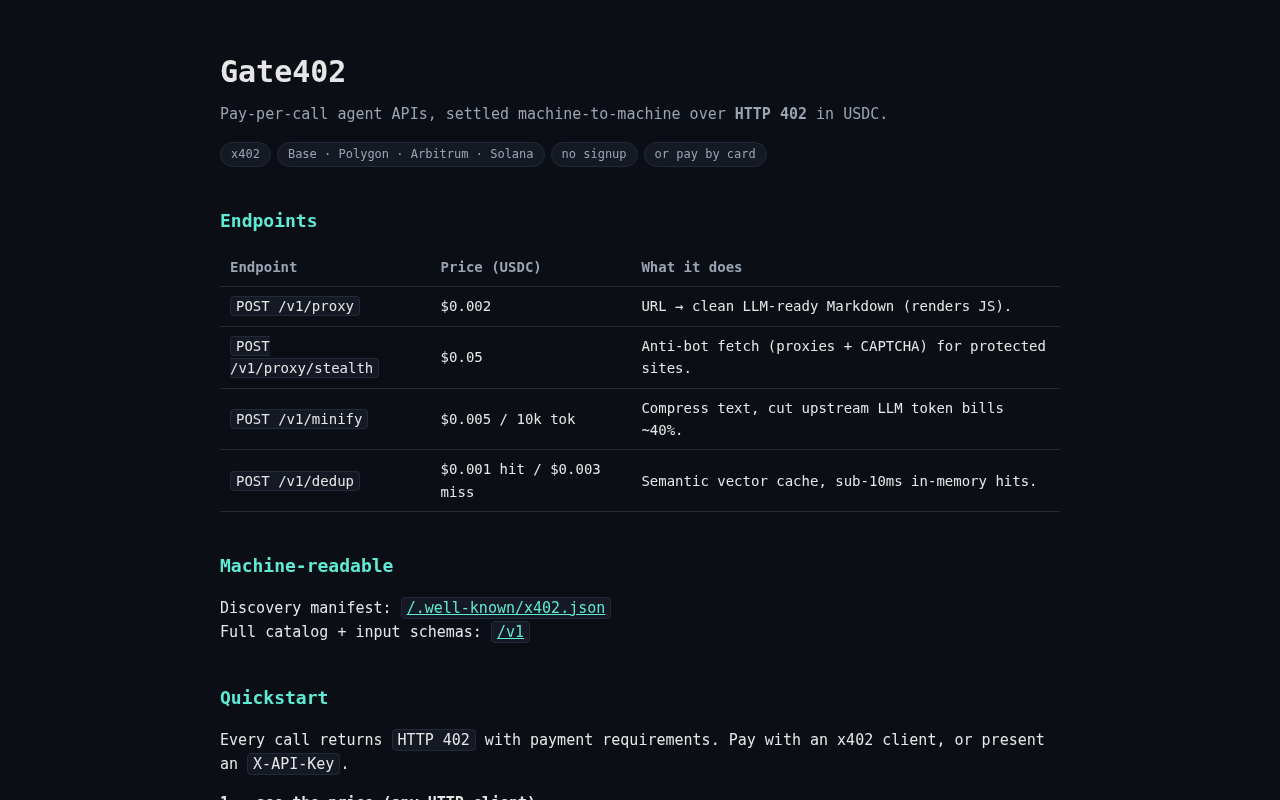
That is exactly what gate402 does: you register an endpoint and a price, and it exposes a machine-payable /v1 storefront that agents can discover and pay per call — settling real USDC on-chain in under two seconds — while your service just answers requests.
Which should you pick?
Building the payment stack yourself is worth it if payments are your product. If you just want your existing API to be payable by agents this week — without becoming a payments engineer — front it with a gateway and move on.
Making Agents Actually Find You
A payable endpoint nobody knows about earns nothing. The other half of monetizing for agents is discovery — publishing your endpoint in the machine-readable places agents look: an OpenAPI description, an agent “card,” an MCP registry, an x402 directory. An agent given a task should be able to find your service, read its price, and decide to pay, all without a human in the loop. Design the 402 response and your listing for a machine reader, not a marketing page.
Don’t Skip the Guardrails
Charging machines introduces machine-scale failure modes. Build these in from the start:
- Idempotency. An agent will retry. Make sure one payment maps to one delivery, and a replayed payment proof can’t buy twice or be double-spent.
- Rate limiting. Per-call pricing does not remove the need for limits — a buggy agent in a loop can hammer you even while paying.
- Clear failure responses. When payment is missing, insufficient, or invalid, say so in a structured way the agent can act on, not a generic error page.
- A price that survives volume. Fractions of a cent are the point, but make sure your unit economics still work when an agent calls you ten thousand times in an afternoon.
Worth trying now?
Monetizing an API for AI agents is not a bigger version of subscription billing — it is a smaller, simpler thing. Answer 402 Payment Required with a price, accept a per-call payment, return the data. You can build that handshake yourself, or front your service with a gateway and have machine-payable pricing today. Either way, the shift is the same: your API stops waiting for humans to sign up and starts getting paid by the software that actually wants to use it.
Want to make your API payable by AI agents without building the payment stack? That’s exactly what gate402 is for — and if you want a custom agent-payments integration built end to end, that’s what we do at Rebel Studios.