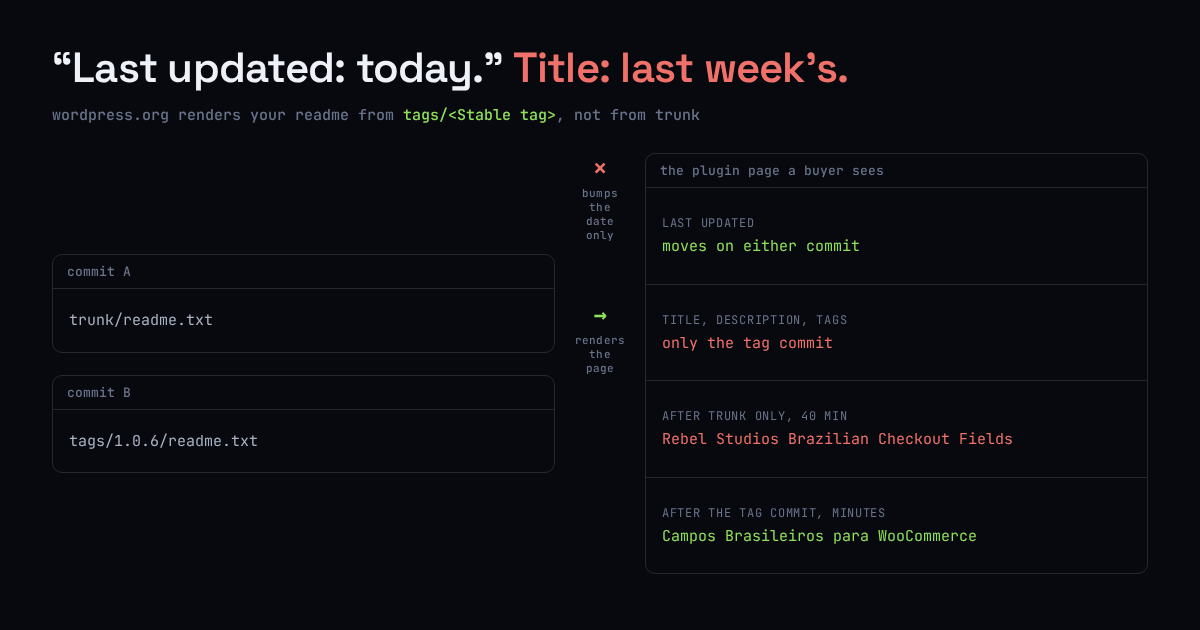
Our Brazilian checkout plugin was invisible for the phrases Brazilian shop owners actually type. The listing led with our studio name and described itself in English, while every plugin outranking us was in Portuguese. So I rewrote it: Portuguese title, Portuguese short description, Portuguese first in the body with English kept below.
Then I committed it, and watched nothing happen.
Forty minutes of a page that said it had changed
The commit went through cleanly. Reading the file straight back off the server confirmed the new title was there:
$ svn cat https://plugins.svn.wordpress.org/our-plugin/trunk/readme.txt | head -1
=== Campos Brasileiros para WooCommerce – CPF, CNPJ e CEP com validação ===
And the directory's own API, asked for the same plugin, kept answering with the old one:
NAME:    Rebel Studios Brazilian Checkout Fields for WooCommerce
UPDATED: 2026-11-19 9:10am GMT
I waited. Checked again at twenty minutes, then at forty. Same answer.
The detail that makes this worth writing down
A trunk commit does move the plugin page's “Last updated” date. So the page looks like it noticed you. Mine still said 19 November because that was the last revision that had reached the right place, but had I committed on a day with no prior activity, I would have seen a fresh date sitting above stale text and concluded the cache just needed longer.
That is the failure worth naming: not an error, but a success signal for work that did not land. A commit that appears to have shipped and has not is worse than one that visibly fails, because nothing prompts you to look again.
The cause: your Stable tag is a pointer
A readme.txt in a WordPress plugin carries a line like this:
Stable tag: 1.0.6That tells the directory which copy of your plugin is the real one. It governs the download, and it also governs the readme it renders: title, short description, description, tags, FAQ. All of it comes from tags/1.0.6/readme.txt.
So editing trunk/readme.txt changes what a developer reading your repository sees, and nothing a buyer or the search index sees. The exception is Stable tag: trunk, which makes trunk authoritative — and which most released plugins do not use.
Committing the same file to the tag took effect in minutes:
NAME:    Campos Brasileiros para WooCommerce – CPF, CNPJ e CEP com validação
UPDATED: 2026-11-20 5:49pm GMT
Then I got the diagnosis wrong in the other direction
Having found the trap, I assumed it was a habit. I went back through the recent readme commits on that plugin and reported that four of them had been trunk-only too, which would have meant weeks of listing work that never reached anyone, and that a rank measurement I had taken was a baseline for a change that never shipped.
That was wrong, and one command said so:
$ svn log -v -r 3809746
      M /plugin/tags/1.0.6/readme.txt
      M /plugin/tags/1.0.6/leia-me.txt
      M /plugin/trunk/readme.txt
      M /plugin/trunk/leia-me.txt
Both paths. Correctly. The same for the revision after it. The only trunk-only commits in that history were the two I had just made, because I had checked out .../trunk on its own and never had the tag in front of me:
svn co --depth=files https://plugins.svn.wordpress.org/plugin/trunkThe process was fine. I broke it, then briefly blamed it on everyone who had done it properly. Worth saying plainly, because the useful version of this lesson is narrower than the one I first drew: the risk is not that people forget the tag, it is that a partial checkout makes forgetting it invisible.
The check that catches it
Read the title back off the directory's own API, and compare the title, not the date:
curl -s -G "https://api.wordpress.org/plugins/info/1.2/" \
  --data-urlencode "action=plugin_information" \
  --data-urlencode "request[slug]=your-plugin-slug"
Two things about that command. --data-urlencode is not decoration: an unencoded request[slug] gets glob-expanded by your shell and the API answers with an empty body, which reads exactly like “no such plugin” and sends you hunting for the wrong bug. And check the field you actually changed. last_updated moving tells you a commit happened somewhere; only the title tells you it happened where it counts.
What I would tell someone shipping a readme change
- A readme-only change is two commits, trunk and the stable tag, or it has not shipped.
- Check out the plugin root, not
trunk. A checkout that cannot see the tag is a checkout that cannot remind you about it. - Verify the field you edited. Reading back a date to confirm a text change is how an unshipped change passes for a shipped one.
- When you find a trap, check whether it is actually a pattern before you say it is. One
svn log -vwould have saved me a wrong claim.
What this does not tell you
Whether the Portuguese rewrite works. It went live today, and the honest answer to “did it move us” is that it is too early to say — the listing has been Portuguese for a matter of hours. We record a rank measurement daily so that the before and after are both real numbers rather than an impression, and the plugin has zero installs as I write this, so there is nothing to dress up. If the rename does nothing, that will be the next post.
The plugin is Campos Brasileiros para WooCommerce, free, and the companion piece on the tag slot that started this is here.