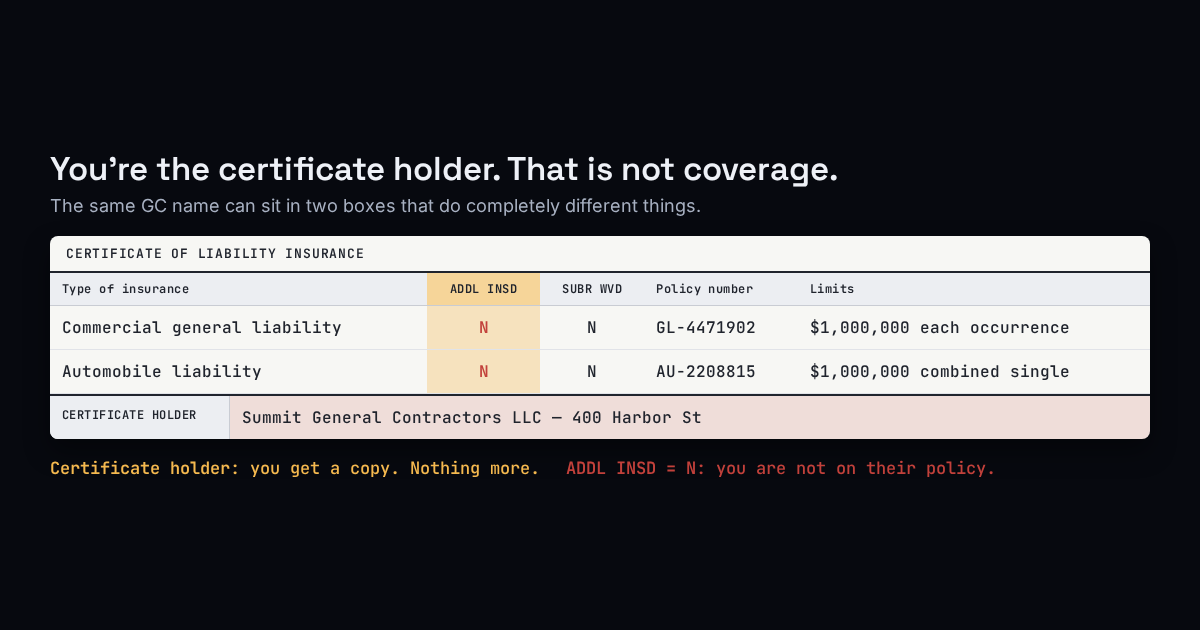
You asked a subcontractor for a certificate of insurance before letting their crew on site. It came back with your company’s name printed right there in the box at the bottom. The limits look fine. You filed it. Done.
Except that box — the Certificate Holder box — is the one place your name can appear on a certificate that gives you no coverage at all. It is the most common reason a general contractor thinks the risk sits with the sub when it still sits squarely with them.
A quick note before we start: this is a general explainer, not insurance or legal advice. Your contracts and your state’s rules govern the specifics; confirm the details with your broker or attorney.
What the certificate holder box actually is
On the standard ACORD 25 certificate, the certificate holder is simply the party the certificate was issued to — the entity that gets a copy as evidence that a policy exists. That is the whole function. It is closer to an address label than to a grant of coverage.
The certificate itself even says so. Every ACORD 25 carries a line of disclaimer text at the top: the certificate is issued as a matter of information only, confers no rights on the holder, and does not amend, extend or alter the coverage in the policies below. In plain terms: being the certificate holder gives you the right to be told a policy is in force, and nothing else.
The trap in one line
“My name is on the certificate” and “I am covered by their policy” are two different statements. The certificate holder box only makes the first one true.
What actually puts you on their policy
The thing that extends a subcontractor’s coverage to you is an additional insured endorsement — an actual change to their policy that names you (or a class of parties that includes you) as an insured. When you are an additional insured, the sub’s insurer defends and pays on your behalf for claims arising out of the sub’s work. That is the risk transfer you were trying to buy when you asked for the certificate in the first place.
On the certificate, that status does not show up in the certificate holder box. It shows up in two other places:
- The ADDL INSD column in the coverage table — a narrow column with a “Y” next to each line of coverage that includes you.
- The Description of Operations box, which should reference the specific additional insured endorsement form (for general liability, often CG 20 10 for ongoing work and CG 20 37 for completed operations) or a blanket endorsement in the policy.
A certificate can have your name in the holder box, a comfortable set of limits, and an ADDL INSD column that is blank or marked “N” on every line. That is a certificate that protects the subcontractor beautifully and protects you not at all. (For a deeper look at additional insured and its companion, waiver of subrogation, see the endorsements that actually protect you.)
Reading the two side by side
| Certificate holder | Additional insured | |
|---|---|---|
| What it means | You received a copy of this certificate. | You are covered under the sub’s policy for claims from their work. |
| Where it appears | The holder box, lower left of the form. | The ADDL INSD column, plus a named endorsement in Description of Operations. |
| Changes the policy? | No. Information only. | Yes. It is an endorsement to the policy. |
| Protects you in a claim? | No. | Yes — if the wording and the named entity are right. |
Three ways this goes wrong even when someone tried
Most of the time nobody is being sly. The gaps show up because a certificate is quick to issue and slow to read:
- Holder filled, ADDL INSD blank. The most common case. Your name is in the box; the column that matters is empty. It looks handled at a glance and is not.
- “Additional insured per attached endorsement” — with nothing attached. The description box references an endorsement that never came with the certificate. You cannot confirm the wording covers completed operations, or covers you at all, from a reference you can’t see. The endorsement form, not the certificate, is the thing that grants the coverage.
- Right project, wrong entity. The endorsement names your operating company, but the contract is signed by a different LLC, or a parent, or the property owner you owe indemnity to. An additional insured endorsement only covers the entity it names.
The one-sentence takeaway
If you only check that a certificate arrived with your name on it, you are checking the one field that never has to be true for you to be covered.
What to require, and what to check
Two things close most of the gap. First, put the requirement in the subcontract in writing: the sub names you as additional insured on a primary and non-contributory basis, for ongoing and completed operations, with a waiver of subrogation. Second, when the certificate arrives, look past the holder box:
- Is ADDL INSD marked “Y” on the general liability line (and any other line your contract requires)?
- Does the description box name a real endorsement form, and did that endorsement actually come with the certificate?
- Does the endorsement name your contracting entity, spelled the way your contract is signed?
- Are the coverage dates current, so all of this is in force for the work happening now?
Done by hand, across every sub on every project, that is exactly the kind of tedious verification that gets skipped under deadline pressure — and stays skipped until the one claim where it matters. The failure isn’t missing paperwork; it’s paperwork that looks complete. (The same reason a spreadsheet of certificates quietly stops protecting you.)
This is the check we built into TradeGuard Pro: it reads each certificate for additional insured status and the named entity, not just that a document was collected, and flags the ones that arrived looking fine but wouldn’t hold up. The name in the holder box is where most tools stop looking. It’s where the exposure starts.
Managing subcontractor certificates and want the ADDL INSD column checked for you? See how TradeGuard Pro tracks it, or if you want compliance software built around your own workflow, that’s what we do at Rebel Studios.